 Sports Revelation Online ..breaking authenic sports reports
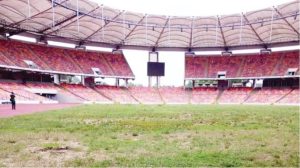
National Disgrace….Sorry Sight of main bowl of Moshood Abiola National Stadium Abuja
By Harry Awurumibe, Editor-in-Chief, Abuja For Nigeria’s 11 national teams including Super Eagles and Super Falcons, expectations of playing their international football matches in the Federal Capital Territory (FCT) Abuja anytime soon will remain a pipe dream as both the federal government and the
Federal Capital Territory Administration (FCTA) are not thinking of providing standard sports infrastructures in the territory anytime soon for the use of Nigeria’s sportsmen, women and teeming fans.
This is even as the only international stadium in FCT, the Moshood Abiola National Stadium Abuja has been out of use for Super Eagles matches for over four years, dating back to March 29, 2022.
Recall that the National Sports Commission’ earlier this year said that Nigeria plans to spend over ₦24 billion on the rehabilitation of the Moshood Abiola National Stadium Abuja, as part of the NSC’s ₦203.6 billion budget for 2026. The allocation is said to cover major upgrades to the main bowl, completion of a high-performance centre, and supporting infrastructure, amid a wider push to revive sports facilities and prepare for major international competitions.
But the senior national team last played a competitive fixture at the venue during the 2022 FIFA World Cup playoff second leg against Ghana which ended in a 1-1 draw which was not enough for Nigeria to qualify for the World Cup in Qatar in 2022.
Following that game, world football governing body, FIFA slammed an indefinite ban on Moshood Abiola National Stadium Abuja from hosting international matches due to a pitch invasion by irate fans after Nigeria failed to qualify for the World Cup.
Also, the Confederation of African Football (CAF) and football authorities subsequently moved Super Eagles home fixtures such as African Cup of Nations
(AFCON) qualifiers to venues like the Godswill Akpabio International Stadium in Uyo, citing standard and security concerns.
In the same vein, matches involving the Super Falcons and other national teams have been moved to Remo Stars Sports Complex in Ikenne-Remo and Moshood Abiola Stadium in Abeokuta, Ogun state.
Other national teams playing their international matches away from Abuja are the home-based Super Eagles, Olympics Eagles (U-23 boys), Flying Eagles (U-20 boys) and Golden Eaglets (U-17 boys) as well as Falconets (U-20 women’s) and Flamingos (U-17 women’s).
Sadly, with most of the national teams having international engagements regularly and setting up training camps in FCT, the need for good training facilities for the country’s teams to do well in international engagements have become very challenging for the coaches, players and the Nigeria Football Federation (NFF) which manages the teams on behalf of Nigeria.
The none availability of good training facilities or sports infrastructures across Nigeria and in FCT in particular have made the various national teams especially the Super Eagles and Super Falcons not to do well in their international engagements.
Also lack of sports infrastructures in FCT
have ensured that Nigeria’s national teams lacked home ground advantage that comes with playing home matches on familiar playground in big games.
Aside from the Moshood Abiola National Stadium Abuja, three others at the Old Parade Ground in Area 11, Garki with just 5,000 capacity; Area 3 Playground and Gwari Township stadium in Gwari, all in FCT provide no alternative for the national teams as they lack everything that is required in stadium like dressing rooms, stands and floodlights.
Surprisingly, as the national football teams suffer adversely from lack of training facilities in FCT, the only standard multi-sports facility Moshood Abiola National Stadium Abuja has remained in comatose since four years and counting.
with the National Sports Commission (NSC) headed by Chairman Mallam Shehu Dikko unable to make the sports arena functional since his appointment two years ago.
Recall that the former Sports Minister Sunday Dare during his regime in 2020 under his pet programme called Adopt-A-Pitch Initiative convinced Africa’s richest man Alhaji Aliko Dangote through his Dangote Group to
accept to renovate the Moshood Abiola National Stadium Abuja to the tune of one million United States Dollars.
On Wednesday, August 26, 2020, then Minister of Sports, Dare flagged off and handed over the mainbowl pitch of the Moshood Abiola National stadium Abuja to the Dangote Group for the commencement of renovation by Messers Aron Nigeria Ltd.
The renovation work on the pitch was expected to last for 24 weeks, it went beyond the timeline but was completed and handed over to the federal government ahead of the ill-fated Eagles flight to Qatar 2022 World Cup African qualifiers second leg match against Black Stars of Ghana in Abuja.
However, the renovated mainbowl pitch project which cost Dangote Group One Million US Dollars to ensure that the pitch is restored to world class, has become a shadow of itself and has remained under lock and key while all the categories of Nigeria’s national teams and clubsides playing in the continent are left searching for FIFA or CAF-approved stadia across the country to host their home matches.
Unfortunately, the so-called “Giant of Africa”, a country of over 220 million people can only boast of one single FIFA-approved stadium, Godswill Akpabio International Stadium in Uyo, Akwa Ibom state, the adopted home venue for Super Eagles matches.
The prevailing lack of sports infrastructures or facilities associated with Nigeria is in sharp contrast with what obtains in the Kingdom of Morocco, a nation less endowed in mineral resources such as crude oil and natural gas.
For example, unlike Nigeria’s capital city of Abuja, the administrative capital of Morocco, Rabat has four major standard, modern football playing stadiums that meet international and continental tournament specifications.
The Four Stadia in Rabat alone are:
* Prince Moulay Abdellah Stadium. This is the flagship venue. It holds about 68,700 to 69,500 people. It serves as the home ground for the national team.
* Moulay El Hassan Stadium. It holds 22,000 people. It hosts local club matches for FUS Rabat.
* Rabat Olympic Stadium. This annex venue holds 21,000 people. It supports major multi-sport events and regional games.
* Stade Al Barid. This modern stadium holds 18,000 people. It was built to host international tournament group stages and knockout matches.
In fact, Morocco boasts of no fewer than 12 FIFA/CAF-approved high-standard international venues, with dozens more professional and municipal fields across the country.
Morocco features several elite stadiums that meet strict international standards for FIFA and continental tournaments such as:
* Ibn Batouta Stadium (Tangier): 75,600 capacity
* Prince Moulay Abdellah Stadium (Rabat): 68,700 capacity
* Adrar Stadium (Agadir): 45,480 capacity
* Marrakesh Stadium (Marrakesh): 45,240 capacity
* Stade Mohammed V (Casablanca): 45,000 capacity
* Fez Stadium (Fez): 45,000 capacity.
According to the available records, the list of football stadia in the Kingdom of Morocco are over 40 notable professional and regional stadia listed with capacities ranging from 5,000 to over 35,000 spectators.
Yet, hundreds of smaller standard grass pitches and community grounds exist nationwide to support local leagues and youth development, a trend which is lacking in Nigeria especially in FCT where recreational facilities and sports infrastructures are not available for citizens’ use especially in FCT.
***To be continued tomorrow*****