***Continued from yesterday****
By Harry Awurumibe, Editor-in-Chief, Abuja
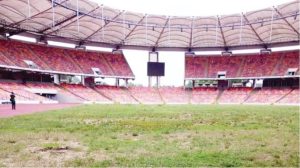
National Disgrace….Sorry Sight of main bowl of Moshood Abiola National Stadium Abuja
Like what obtains in Morocco, Republic of South Africa has roughly 40 to 50 major sports stadiums that can host standard football matches, with 12 to 13 elite venues fully approved by FIFA and CAF for high-level international tournaments.
These include:
*FNB Stadium (Soccer City): Johannesburg (Capacity: ~94,700—the largest in Africa).
*Moses Mabhida Stadium: Durban (Capacity: 54,000–56,000)
*Cape Town Stadium (DHL Stadium): Cape Town (Capacity: 55,000)
*Loftus Versfeld Stadium: Pretoria (Capacity: ~51,700)
*Nelson Mandela Bay Stadium: Gqeberha / Port Elizabeth (Capacity: ~46,000)
*Free State Stadium (Toyota Stadium): Bloemfontein (Capacity: ~42,000)
*Royal Bafokeng Sports Palace: Phokeng / Rustenburg (Capacity: ~44,500)
*Mbombela Stadium: Nelspruit (Capacity: ~40,900)
*Orlando Stadium: Soweto (Capacity: ~37,000–40,000)
*Peter Mokaba Stadium: Polokwane (Capacity: ~45,500)
*Lucas Masterpieces Moripe Stadium: Pretoria (Capacity: ~28,900)
*Athlone Stadium: Cape Town (Capacity: 30,000)
*Dobsonville Stadium: Soweto (Capacity: 24,000).
In fact, South Africa leads the continent with the highest number of top-tier, CAF-approved stadiums equipped with natural grass and modern floodlights with its commercial capital Johannesburg hosting about 5 major, well-known standard stadia primarily used for professional football and international matches.
These are:
*FNB Stadium ( also called Soccer City). The largest stadium in Africa, holding 94,736 people, located in Nasrec near Soweto.
*Ellis Park Stadium (Emirates Airline Park): A historic venue with a capacity of 62,567.
*Orlando Stadium in Soweto with a capacity of 40,000, home to the Orlando Pirates.
*Johannesburg Stadium, an athletics and multi-use stadium holding 37,500 people.
*Rand Stadium,
Johannesburg, with a smaller capacity utilized for local fixtures and training.
*Dobsonville Stadium, situated in Soweto with a capacity around 24,000, frequently hosting local Premier Division matches.
In addition, there are smaller community fields and school grounds existing throughout the metro area, these are the primary standard professional stadiums serving the city’s major football clubs and events.
Meanwhile, near home here in West Africa, Ivory Coast boasts of six major, international-standard football stadia that meet CAF and FIFA requirements with two world-class, international standard football stadia in Abidjan that are certified by CAF.
These venues were built or heavily upgraded to host the 2023 AFCON. They are:
*Alassane Ouattara Stadium (Stade Olympique d’Ebimpé).
Located in Abidjan, capacity 60,000.
*Stade de la Paix (Peace Stadium) – Located in Bouaké, capacity 40,000.
*Félix Houphouët-Boigny Stadium – Located in Abidjan, capacity ~33,000 to 45,000.
*Charles Konan Banny Stadium – Located in Yamoussoukro, capacity 20,000.
*Amadou Gon Coulibaly Stadium – Located in Korhogo, capacity 20,000.
*Laurent Pokou Stadium–Located in San Pedro, capacity 20,000.
In addition to these six top-tier venues, the country also features smaller regional and club grounds (such as Stade Robert Champroux in Abidjan) that host domestic league matches.
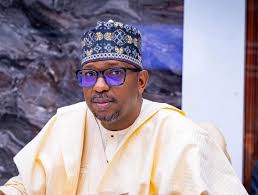
NSC Chairman Mallam Shehu Dikko…..Mute over the renovation of the main bowl of Moshood Abiola National Stadium Abuja.
Also, Nigeria’s neighbours Cameroon currently has five stadia officially certified and approved by FIFA and CAF) to host international standard matches.
CAF-Approved international match venues are:
*Paul Biya Stadium (Olembe Stadium) – Yaoundé (60,000 capacity)
*Japoma Stadium – Douala (50,000 capacity)
*Ahmadou Ahidjo Stadium – Yaoundé (42,500 capacity)
*Roumdé Adjia Stadium – Garoua (30,000 capacity)
*Limbe Stadium–Limbe
(20,000 capacity).
This is even as the capital Yaounde boasts of two modern sports venues, featuring a 60,000-seat capacity Paul Biya Stadium with a state-of-the-art facilities and Ahmadou Ahidjo Stadium, a historic multi-purpose stadium in the Mfandena district with a capacity of about 42, 500 persons.
A closer look at the huge numbers of FIFA and CAF-CAF-certified standard international stadia available in Morocco, South Africa, Ivory Coast and Cameroon, four countries examined in this report clearly showed that Nigeria is miles behind many African countries in terms of the availability of standard stadia that meet CAF and FIFA requirements.
It is a big shame that a country that prides herself as *the giant of Africa* cannot boast of six FIFA and CAF-Aproved standard stadia that can host international matches in, at least, six geo-political zones of Nigeria.
Interestingly, in all the four countries used as examples, their capital cities host, at least two world-class stadia with Morocco’s capital Rabat having five FIFA and CAF-certified standard international stadia while Nigeria has none at the moment.
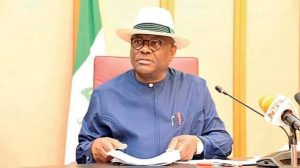
FCT minister Mr. Nyesom Ezenwo Wike…..Failed to provide sports infrastructures in FCT in 3 years.
Sadly, all the efforts made to get the FCT minister Mr. Nyesom Ezenwo Wike to speak to the lack of sports infrastructures in Abuja proved abortive as he could not reach at the time of filing this report even as the NSC Chairman Mallam Shehu Dikko and the Director General Honourable Bukola Olopade did not reply the messages sent to them to comment on the lack of sports infrastructures in FCT and why they have not been able to fix the dilapidated mainbowl of the Moshood Abiola National Stadium Abuja.
With uncertainty hovering over when the mainbowl of Moshood Abiola National Stadium Abuja will become functional again, the possibility of the Super Eagles, Super Falcons and other national teams playing their international home matches in FCT will not materialise in the near future.
 Sports Revelation Online ..breaking authenic sports reports